
Russell's legacy reveals + my apology
File under: Legacy sales tips
You said…
"Stop the promos!"
Then you threatened to unsubscribe. More than one of you. You deserve my apology.
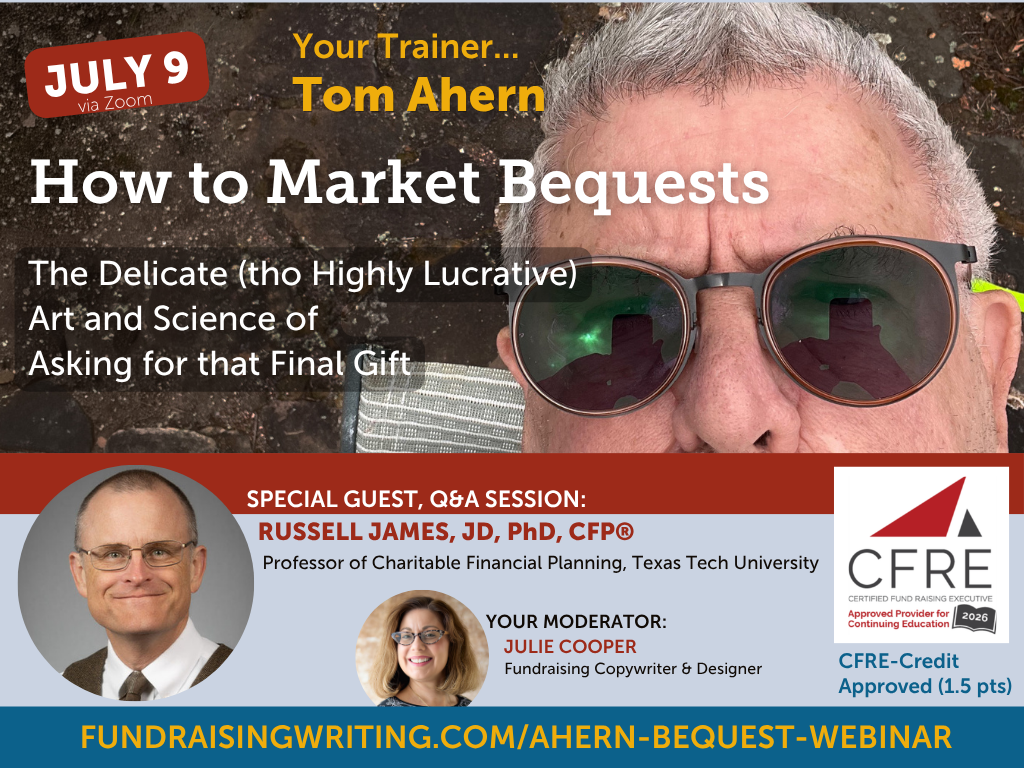
Bing! Bing! Bing! Will it never end?
I sent 13 separate emails, to sell you a seat to my snake oil. Sometimes two a day, as the webby neared. When this pelting by promos finally shut down, a director of development at a university wrote us:
I respect Tom Ahern — very much. But did no one feel this might annoy recipients?
He's right. A hailstorm of promos is annoying, especially once you've registered for something. Wish I had better techno-chops. I'd fix the problem....
Please accept my honest apologies.
Simple real reason: Had to be done. It was a "pull the ripcord" moment or SPLAT!
See: we need at least 150 attendees. With a crowd that big, a profound, wide-ranging Q&A can bloom. We had one recent Q&A stretch past 3.5 hours...because we had enough people and a great expert.
For years, 150+ folks was an easy number to make, into early 2025. Then things got strange—as if the fundraising world hit PAUSE. Nobody signed up for anything. Top consultants wept.
So in 2026, obeying Marketing 101, we hammer our lists, to make the 150 minimum. People wait and wait. Our second heaviest day of registrations in July was the DAY OF the webinar itself; think the last fundraiser clocked in less than an hour before the start.
It's a reluctant time we're living through. I blame the midterms....
Meet advertising's pimply secret weapon: REPETITION
Fundraisers: inattention is your enemy, with the usual human inertia. And it's your fault, because you're innately shy. Afraid to offend. So you quit promoting too soon.
I assume this instead: that most people will ignore almost all ads (including my webby promos) all the time, as much as they can, in defense of their sanity. I know I do.
They don't hate you. They ignore you. Tolerate you. Complain about you. And maybe next time they encounter your email promo, they'll respond differently. Moods change. Marketing 101. Maybe a third (or 13th) promo email will be "my lucky charm."
Experience shows that running the same ad 3 times can produce significantly more response than running that ad just once; 6 reps more than 3; and 12 reps more than 6.
Repetition is your friend. You're welcome; you just learned something.
BONUS: Here's an advertising-copy formula I depend on a lot: AIDA.
My best apology, though...
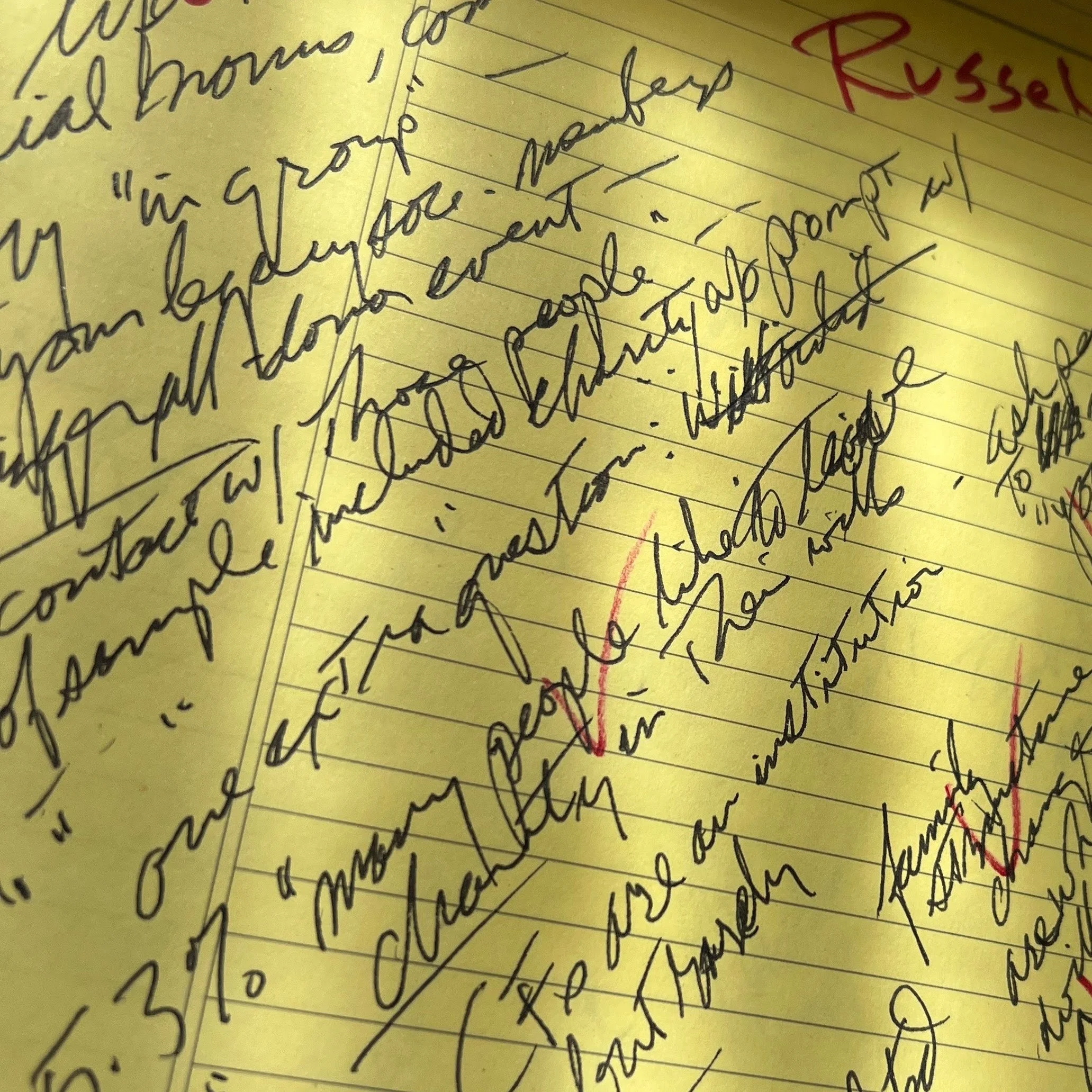
...comes in the form of sharing some intriguing notes I scribbled down as Dr. Russell James III, lawyer, economist, professor, author, researcher answered attendees' questions for 1.5 hours. I ended up with three pages of surprises.
Right away, I learned a new fundraising term: "lost-gift rate." It's something you want to keep your eye on.
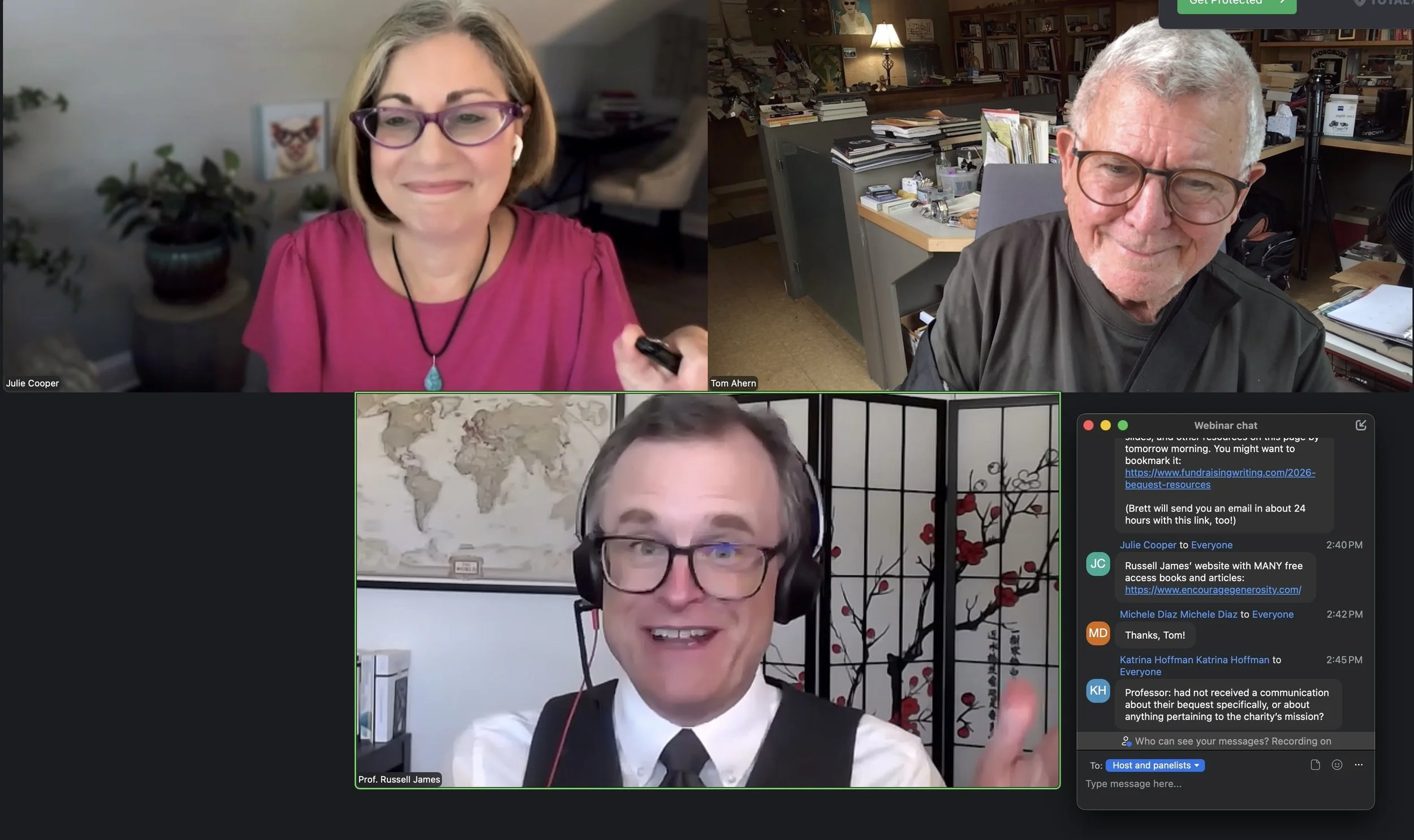
Below, clockwise: Julie Cooper moderates, scribbler, Q&A superstar Dr. Russell James
"Lost-gift rate?" you ask. Doesn't sound too dangerous.
Well, let's say you're setting up a bequest-marketing pipeline (as charities serious about sustainability do).
So you're following, with your usual well-tempered excellence, the formula we teach you for $129 per seat: based on best practices, Richard Radcliffe a.k.a. Dr. Death; Prof. Russell's vast research and knowledge; seasoned with successful front-line fundraising experience gathered from six English-speaking countries.
That formula says: When someone formally pledges to include your charity in their will, enroll them, by name or anonymously, as a member of your Legacy Society.
But wiseguys want to know: So then what happens? How much money can you count on in the end...really? Bottom line: What % of your legacy pledgers keep their promise?
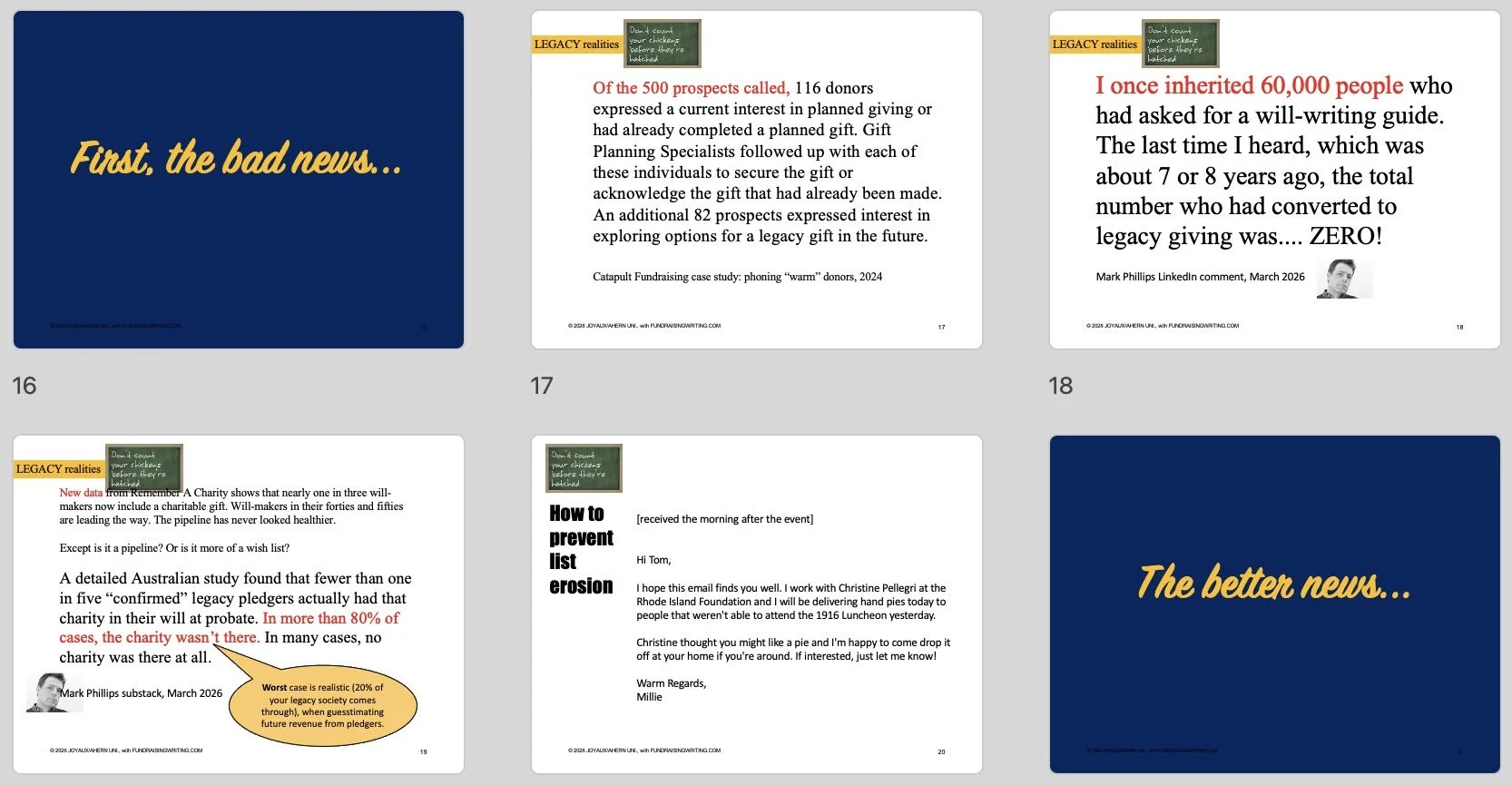
It will be less than 100%—maybe far less, probate data shows. Russell's research has seen lost-gift rates as high as 60% at charities he's studied. Yikes: that means 10 people joined your splendid legacy society, but only four actually got around to writing your charity into their wills.
Be a pessimist. Trust me. Stay in touch with older donors.
---
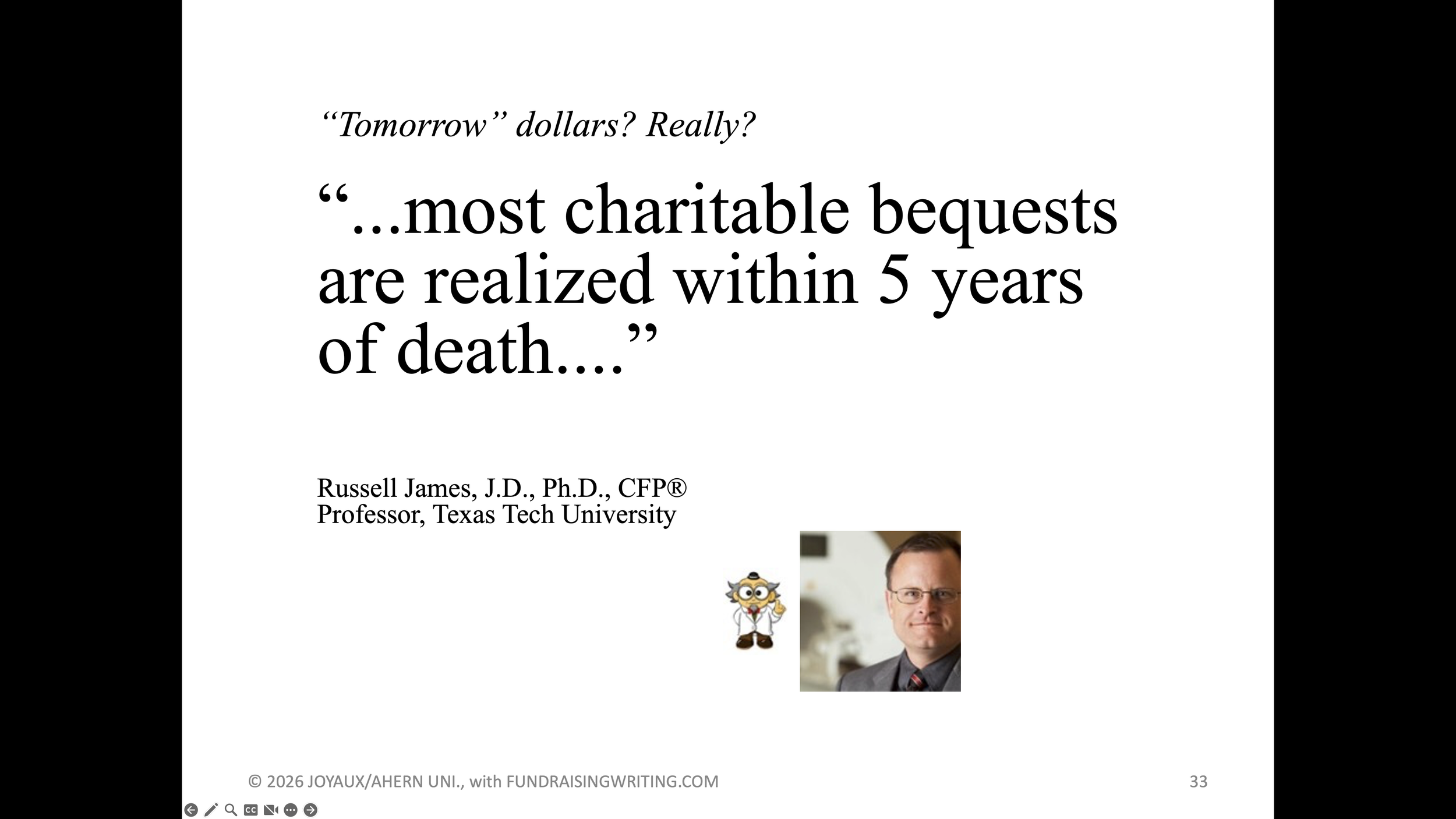
Below: A sequence of slides discussing the realities of legacy marketing; one great source for updated data: Mark Phillips
There's one standard practice that will devastate your lost-gift rate.
RECENCY is the surprising villain. Many charities, as a matter of routine list hygiene, eventually stop communicating with donors who "lapse." Russell's deeper research found the worm in that particular apple. Some of your best legacy prospects—long-time supporters—will predictably cease giving (to even favored charities) a few years before they die, for a huge number of reasons you can do nothing about. It's a law of nature. Life. A fact of aging. It will happen...and then those same good folks will make a final will, from scratch.
You may not make that last cut. They haven't rejected your mission. It's just...you're not "top of mind," one of Russell's favorite nudges. (PS: And your best donors probably have no idea how important legacy gifts are to driving the mission forward.) They've lost the connection with your best prospects...because you "lapsed" them out of your charity's comms calendar. You fell out of touch solely because they hadn't made a small gift in the past two years (or whatever your in-house rule re: "recency" is), even though they gave faithfully before that. Russell shook his head. It's a decision that's "precisely designed to fail."
TAKEAWAY: If your "lapsed" donors (ugly industry label and incorrect beyond a certain age) are in their 70s or older, you definitely DO want to stay in touch with them, at a minimum once a year.
---
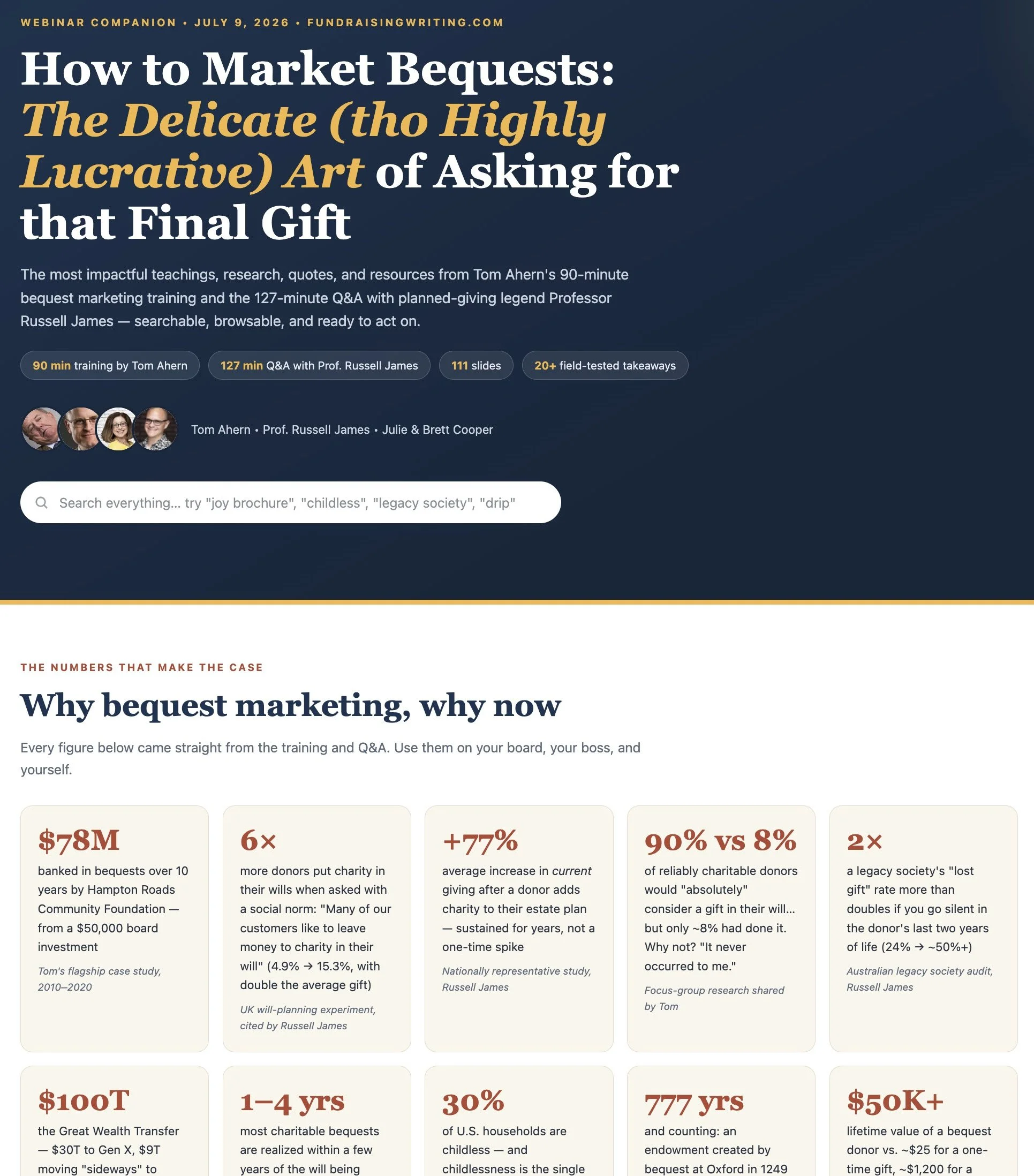
Below: Screen shot of a lengthy PDF sent to registrants after the half-day training was done. It visually summarizes key points from the 3-hour event, both the formal training and the Q&A.
Russell briefs
"When death becomes real, people update their wills." I'm updating mine, BTW. ∑|>•≈} "50 ways to ask for a gift in their will" is a free publication by Russell I couldn't find, but this substitute gives you the idea: it's a huge blast of WOW! ∑|>•≈} References to "people like [us] make gifts like this" and "many people like to leave charity in their wills" produced a much higher response from existing donors. ∑|>•≈} The very first question kicked off a lively discussion. "Do legacy societies matter? Are they worth the trouble?" From Russell's mouth came this gem: "Legacy societies do not work unless you do." ∑|>•≈} Technical terms like ANNUITY is biz/contract language. "Would you have said this to your grandmother?" Just say what various products do: "Gives you income for life." ∑|>•≈} The barrier to legacy fundraising will be the fundraiser's comfort level, not the donor's. • Ask a donor: "If money were no object, what would you like to see happen? What would be your philanthropic victory?" ∑|>•≈} Talking about "How does our family give smarter?" draws far more response than a mention of "estate planning." ∑|>•≈} Yes, Russell agrees, the banner "planned giving" is a dreadful barrier to entry, being strictly insider talk. "How dare you?" Legacy requires smart marketing.

Dear Reader: This is an excerpt from Tom Ahern’s e-newsletter. Did you miss crucial back issues of this how-to e-news? Immediately available! Just GO here. (And scroll down just a bit to sign up for Tom’s revenue-boosting tips and insights. In your inbox regularly. It’s free.)