
Blah, blah, blah: Cases
File under: Questions front-line fundraisers ask...
...about cases
Every year, we offer 4 mega-expert-level webinars ("webbies") on different core topics...each richly updated with hand-picked examples of successful, new donor comms well built to prompt the act of giving...blah, blah, blah. And then we throw the floor open to questions and mysteries get solved.

In 2025, John Lepp—co-founder: Agents of Good, international creative thought-leader and once-upon-a-time YouTuber, starring in The Drunk Chef—was the special guest expert for our signature webby add-on, the "all you can eat" Q&A. That doesn't stop until the questions stop.
This one rambled on for 1.5 hours. With Julie Cooper moderating; Brett Cooper on drums; Tom Ahern interrupting.
Here's a taste. A few pithies that arose...
[Q]: Kristen asks: How long should a case for support be? I've been asked to submit a one pager to a DAF manager, but should our more formal case for support be longer?
[A]: Obviously: if they ask you for one page, you send them a one-page case. It will be a fabulous one-pager, of course: answers the big 3 "why" questions; drops all the jargon and other useless crap; opens with the problem right away, as pioneer miracle fundraiser Si Seymour recommended throughout his stellar career.
• Pro tip: Your charity's need for financial support will depend in part on an emotionally-apt, psychologically-wise case for support. In a case, don't worry about length. Worry about the relevance of what you're saying to your target audience.
[Q]: What's the right ratio of "problem" to "solution"? How much of the "desperate situation" do we need in our case before talking about what we do to address it?
[A]: Many campaigns manage to shrink their raison d'être to one startling statement: "Global warming? Give us your help and seven years." But it matters hugely WHEN your reader encounters that statement.
• "I work with new writers sometimes," John said. "They wander. Take a while to get to what the problem is, or what they're asking for, or they don't even present an actual problem to solve at all, because that's a vulnerable point, right?" Problems make people nervous.
• Confident people, though, get to the point: "Here's the problem you can help us solve today. And here's the solution that's soon possible with your generous support."
• For classroom essays, we learn a standard formula: first you haul in your facts, building your case brick by brick; and then (finally) you reach a conclusion. But that formula is bassackwards in the real world of careening attention spans. Your case cannot afford to fail the "three-second test," when you attempt to snag the most valuable moments in your reader's decision-making process. It's also known as "making a good first impression."
• Pro tip: Get the opening sequence right. Present today's pressing problem IMMEDIATELY, up front, in all its flaming glory, undiminished by jargon. Then present your charity's credible solution and link it to this: "B.O.Y.—Because Of You." Keep the donor firmly fixed inside your story's frame.

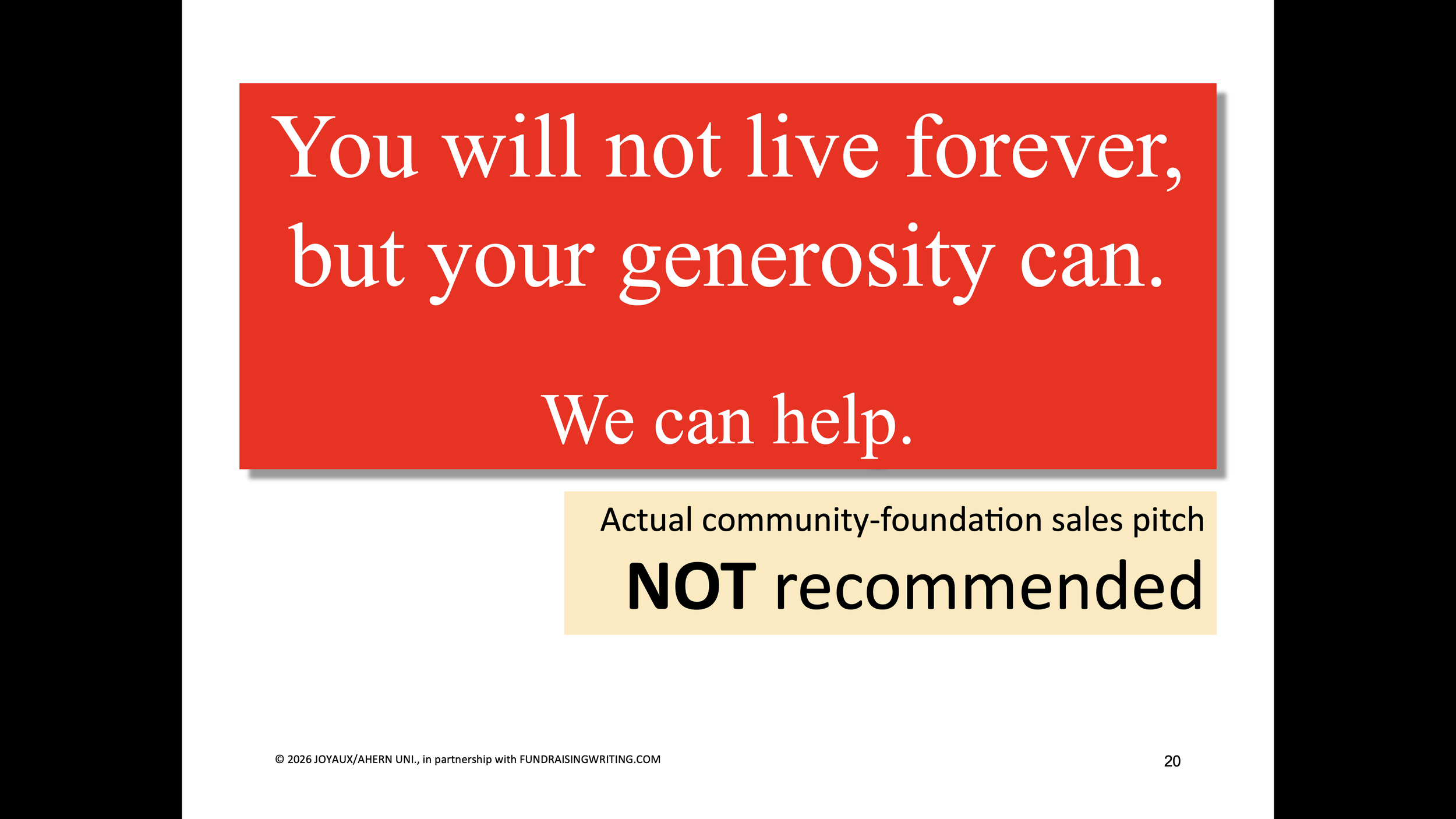
[Q]: Chuck asks this: "My consulting client is a network of faith-based Christian Senior Living campuses. We have soft-pedaled legacy marketing to that audience, fearing it will be remind them of impending death. What is your advice?"

[A]: "Don't worry about it?" Tom said. "Look, I'm 78. I talk to my friends and peers all the time about illness and death." Trust me, that's what you do as you age. It's not always fun. But it's another astonishing fact of life and you're experiencing it firsthand. People start thinking about end-of-life things more intently about two decades before they reach their average life expectancy.
• John wanted to make a special point: "I respect donors. The people we're talking to are freaking adults. Don't treat them like children. They understand. They understand their role. All this shyness away from big truths and stuff, I just don't follow it."
• Rachel Zant agreed in our bubbling audience chat: "We need to stop emotionally managing donors. Tell authentic stories."
• Pro tip: Leave behind your wan excuses. Talk a lot with your true believers about charitable bequests. Legacy is a remarkable offer. Bringing up "death" is your problem, not theirs.
------
AI had the day off. A human wrote the article above.

Dear Reader: This is an excerpt from Tom Ahern’s e-newsletter. Did you miss crucial back issues of this how-to e-news? Immediately available! Just GO here. (And scroll down just a bit to sign up for Tom’s revenue-boosting tips and insights. In your inbox regularly. It’s free.)